"Please note that articles available in PDF
are copyright to the BAA and the authors. Our thanks to the editor of the
Journal of the BAA (Hazel McGee) for providing these PDF's."
Rogers J.H. (1995), 'THE GIANT PLANET JUPITER.'
Cambridge University Press, 1995. 462 pp. inc. numerous illustrations and
colour plates.
ISBN 0 521 41008 8, hardback.
Price 50 UK pounds or 90 US dollars.
(This
book by the Section Director is a comprehensive account of the planet up to
1991, including synthesis of all amateur observations. The hardback
is now out of print but can be obtained on Amazon.com. A digital paperback
edition [without colour pictures] will be available from CUP in 2009.)
Memoirs BAA Vol.43, Part 1 (1990): ' JUPITER, 1973-1977: THE PIONEER YEARS'.
[This Memoir consists of four annual reports, by John Rogers, Richard McKim, John Murray, and Mike Foulkes. They cover the period of the first spacecraft visits to Jupiter, as well as the great global upheaval in 1975.]
Memoirs BAA Vol.43, Part 3 (1992): 'JUPITER, 1977-1981: THE VOYAGER YEARS'.
[This is the definitive account of activity on Jupiter during the years that included the Voyager encounters. It contains four Jupiter Section Reports by Mike Foulkes, Richard McKim, and John Rogers. There is also a 16-page Atlas of Voyager images.]
These Memoirs, edited by John Rogers, form part of the BAA's observational record of visual and photographic observations of Jupiter, from amateur astronomers in Britain and around the world.
Final reports on the Comet Shoemaker-Levy 9 impacts, in JBAA:
Rogers JH (1996) JBAA 106 (no.2), 69-81. 'The comet collision with Jupiter: I. What happened in the impacts.' [Full review of professional results.]
Rogers JH (1996) JBAA 106 (no.3), 125-150. 'The comet collision with Jupiter: II. The visible scars.' [The Jupiter Section Report on amateur observations.]
Rogers JH, Miyazaki I & Limaye SS (1996) JBAA 106 (no.3), 151-154. 'The comet collision with Jupiter: III. The largest impact complex at high resolution.' [Synthesis of amateur and HST images.]
News note:
Rogers J, Foulkes M & McKim R (1997) JBAA 107 (no.1), 3-5. 'The Great Comet Crash: the view gets clearer'. [Review of Paris conference, plus Galileo close-ups of Callisto & Europa]
All these papers are available collated in this pdf Jupiter_impact_SL9.pdf (17.6MB)
Interim reports in the Journal of the British Astronomical Association (JBAA):
Rogers J.H. (2002 Feb.) JBAA 112 (no.1), pp.2,8,9: Jupiter in
2000/2001.
ibid. pp.9-10: Galileo flies through Io's biggest eruption yet.
Rogers JH (2003 June), JBAA 113 (no.3), 126-129 & cover. Moons over
Jupiter: transits and shadow transits. Download in PDF
& ibid. pp.134-135. Moons over Jupiter: the occultations. Download in PDF
Rogers J.H. J.Brit.Astron.Assoc. 111 (no.5) p. 245 (2001). Cassini and Galileo reveal secrets of Jupiter's dark patches. Download
Rogers
JH (2005 Aug.), JBAA 115 (no.4), 188 & cover.
The face of Jupiter in 2005.
Rogers
JH (2006 Oct.), JBAA 116 (no.5), 226-288 & cover.
Jupiter in 2006.
Rogers JH (2007 June) JBAA 117 (no.3), 113-115 & cover. 'Jupiter embarks
on
a global upheaval.' (Interim report, 2007).
LINK TO THE PDF LINK
TO THE COVER PDF
http://www.britastro.com/jupiter/2007report03.htm
Rogers JH (2007 Oct.) JBAA 117 (no.5), 226-230. 'The climax of Jupiter's
global upheaval.' (Interim report, 2007).
LINK TO THE ATTACHED PDF
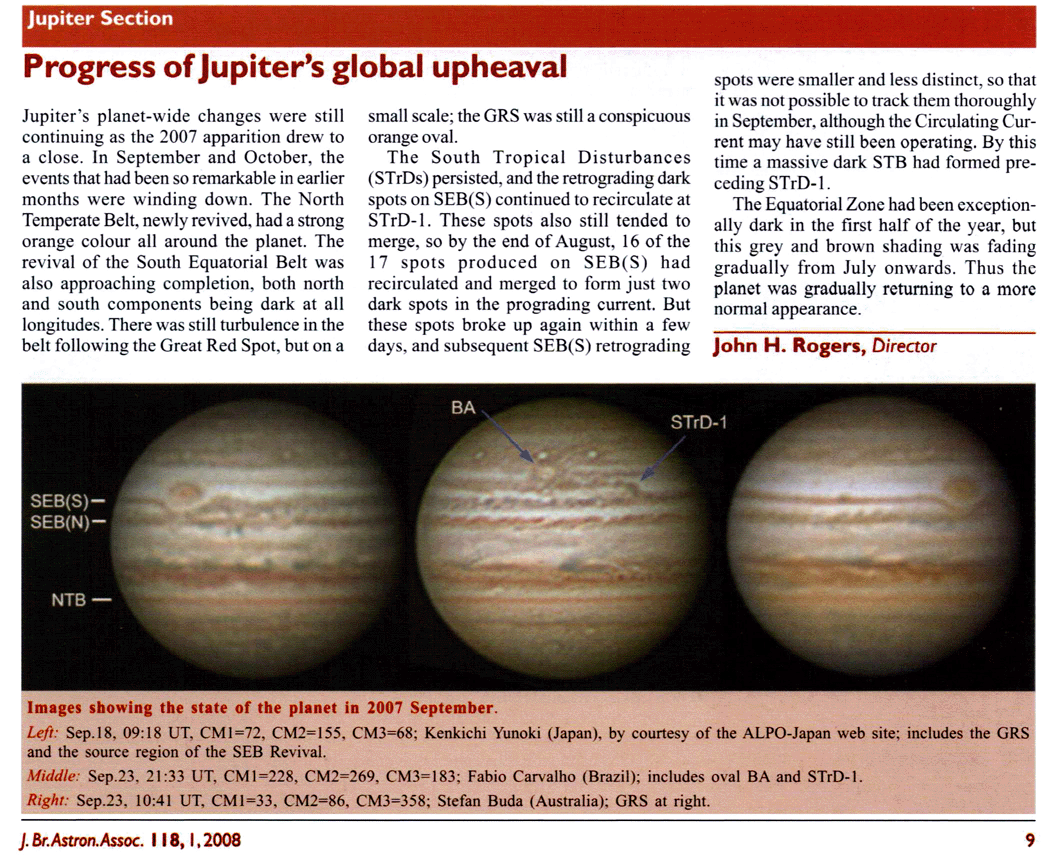
Rogers JH (2008 Feb.) JBAA 118 (no.1), 9. 'Progress of Jupiter's global upheaval.' LINK TO SCAN OF JOURNAL PRINT
Rogers JH (2008 Oct.), JBAA 118 (no.5), 242-244. 'Jupiter in 2008: Aftermath of the global upheaval'. PDF LINK
New papers in press in the JBAA (2007)
These continue our regular comprehensive reports on each apparition of Jupiter; previous ones were also published in the JBAA or in Memoirs.
Rogers JH & Foulkes M (1994), JBAA 104 (no.4), 167-178. Jupiter in 1991/92.
Foulkes M & Rogers JH (2000 Oct.) JBAA 10 (5), 237-252. Jupiter in 1995.
Rogers JH & Foulkes M (2001 April), JBAA 111 (no.2), 67-77. Jupiter in 1996.
Rogers JH (2001 Aug.), JBAA 111 (no.4), 186-198. Jupiter in 1997. Includes: Rogers JH, Foulkes M & Miyazaki I, ibid. pp.197-198, Appendix: Methane band images of Jupiter, 1995-1997. Download in PDF (282kb)
Rogers JH & Mettig H-J (2001 Dec.), JBAA 111 (no.6), 321-332. Jupiter in 1998/99. Download in PDF (208kb)
Rogers J, Mettig H-J, Peach D & Foulkes M (2003 Feb), JBAA
113 (no.1), pp. 10-31. 'Jupiter in 1999/2000, Part I: Visible
wavelengths.'
Download in PDF (617kb) (Figures are of slightly
reduced quality.)
Rogers J, JBAA 113 (3), 136-140 (2003 June). Jupiter in 1999/2000, Part II: Infrared wavelengths. [This includes a review of the properties of various methane filters used for imaging Jupiter. A PDF file is provided with reduced resolution in the images. Download in PDF
Rogers
JH (2008 Feb.) JBAA 118 (no.1), 14-20. 'The accelerating circulation of the
Great Red Spot.' [LINK TO PDF]
Rogers
JH, Mettig H-J, Foulkes M, Peach D, & Cidadão A (2008 April), JBAA 118
(no.2), 75-86. 'Jupiter in 2001/02: Part I.' [LINK
TO PDF]
Rogers
JH, Mettig H-J, Foulkes M, Peach D, & Cidadão A (2008 April), JBAA 118
(no.2), 75-86. 'Jupiter in 2001/02: Part II.'
[LINK
TO PDF]
Also:
Mettig
H-J (2008 June) JBAA (no.3), 169-170. The Merlin Medal and Gift
2007: Hans-Joerg Mettig.
Rogers JH & Mettig H-J. (2008 Dec.) JBAA 118 (no.6), 326-334. 'Influence of Jupiter's South Equatorial Disturbance on jet-stream speed.
LINK TO PDF OF THE PAPER
LINK 2 TO SUPPLEMENTARY ONLINE MATERIAL
Our comprehensive report on Jupiter in 2000/2001 is in 3 parts, as follows.
Rogers J, Mettig H-J, Peach D, & Foulkes M, JBAA 114 (no.4), 193-214.
Jupiter in 2000/2001: Part I: Visible wavelengths: Jupiter during the
Cassini encounter. View summary. Download
complete PDF.
Rogers JH, Akutsu T, & Orton GS, JBAA 114 (no.6), 313-330.
Jupiter in 2000/2001: Part II: Infrared and ultraviolet wavelengths: A review of
multispectral imaging of the jovian atmosphere. View
summary. Download complete PDF.
Rogers JH, Cidadão A, Akutsu T, Mettig H-J, Peach D, Orton GS, JBAA 115
(no.2), 70-78. Jupiter in 2000/2001: Part III: The South Equatorial
Disturbance: A large-scale wave in a prograde jet. [View summary.]
[Download complete PDF.]
Imaging related Articles by Damian Peach:
Peach
D. A.
Astronomy (2004 April) pp.70-73.
Jupiter at its best.
Peach
D. A. (2004 Aug.)
JBAA 114 (no.4), 188-192.
The ultimate location for amateur astronomy?.
Peach
D. A. (2006 Feb.). JBAA 116 (no.1), 11-14.
Predicting astronomical seeing in the UK.
Peach D. A (2007 Dec.) JBAA 117 (no.6), 301-308 & cover. 'Planetary observing missions to Barbados in 2005 and 2006.'
See http://www.damianpeach.com/ for further articles.
Papers published in Icarus:
Rogers
JH, Mettig H-J, and Peach D (2006). Renewed
acceleration of the 24°N
jet on Jupiter. Icarus 184, 452-459.
For subscribers, the article is available online via the following link:
http://dx.doi.org/10.1016/j.icarus.2006.05.007
PDF here: Rogers JH, Mettig H-J, and Peach D (2006). Renewed acceleration of the 24°N jet on Jupiter. Icarus (in press).
Summary:
Jupiter's
eastward jet at 24°N, which formerly had the fastest winds on the planet, has
maintained a less extreme speed of ~135 m/s since 1991, carrying a series of
long-lived vortices at 125 m/s. In
2002-2003, as the albedo of the adjacent North Temperate Belt increased, the
tracks of the vortices accelerated slightly, and they had disappeared by 2005.
In 2005, small tracers had a mean speed of 146.4 (+/- 0.9) m/s,
significantly faster than the previous mean speed of the jet, suggesting that
the jet peak itself has accelerated at cloud-top level, and that the jet is
beginning to return to the super-fast state.
These changes may resemble the even greater transformations occurring in
the equatorial jet of Saturn.
-----------------------------------------------------------------------------------------------------------------------------------------------------------------------------------------------------------------------
Rogers JH, Mettig H-J, Cidadão A, Sherrod PC, and Peach D (2006). Merging circulations on Jupiter: observed differences between cyclonic and anticyclonic mergers. Icarus 185, 244-257.
PDF
here: Rogers
JH, Mettig H-J, Cidadão
A, Sherrod PC, and Peach D (2006). Merging circulations on Jupiter: observed
differences between cyclonic and anticyclonic mergers.
Icarus (in press).
Summary:
The
dynamics of mergers of large circulations in Jupiter's atmosphere may permit
different models of the atmosphere to be tested. We report well-resolved observations of such events at
visible wavelengths: three anticyclonic and three cyclonic events.
A merger of anticyclonic white ovals in the South South Temperate domain
(2002 March) is compared with the previously reported merger of ovals BE and FA
in the South Temperate domain (2000 March).
In each case, the two similar-sized ovals converged rapidly once they
were separated by less than the sum of their diameters; they orbited around each
other anticyclonically during the merger; the merged oval initially had the same
rapid drift as the western parent; and, in an unexpected similarity, a cyclonic
oval emerged westward from the point of merger.
Evidence suggests that a merger of smaller ovals in the North North
Temperate domain (2002 February) had similar dynamics.
In contrast, mergers of cyclonic ovals in the North Equatorial Belt
('barges': 2001 November, 2005 May) proceeded in a different manner.
The two parent barges showed no consistent acceleration towards each
other as they converged; on contact there was no obvious sign of mutual
circulation, and the low-albedo regions had almost passed each other before they
finally merged; and the resulting barge had a drift rate intermediate between
the two parents, and a length that was greater than either parent.
Again, a third such event involving a smaller barge (2002 December)
showed many of the same characteristics. These
observations define different dynamical behaviour during anticyclonic and
cyclonic mergers.
For subscribers, the article
is available online via the following link:
http://dx.doi.org/10.1016/j.icarus.2006.05.022
Web pages maintained by the BAA Jupiter Section Staff.